In my previous post I talked about looking at my server log files to see what kind of search-engine queries brought people to my pages. One such query that I noticed in the log this morning brought a smile to my face:
I don't know who did the search or why they were looking for it, but they certainly found what they were after. It brought them to a set of pages I'd made years ago and had largely forgot about, and didn't know were even indexed by the search engines:
It includes a transcript of a question I asked at a Yahoo! company shareholder meeting, and a subsequent letter to the Yahoo! board of directors.
The letter generated almost no response. I'd heard through the grapevine that one of the executives (not Mr. Semel) was incensed and wanted me to be fired, but smarter heads apparently prevailed. I was contacted by HR for a chat, but otherwise, I got no response.
I then made the web pages which chronicled the story and quietly circulated it among friends at Yahoo! For a while, people I'd never met would come up to me around campus and give me a thumbs up about the pages, or tell me to “keep up the fight”, etc. I eventually got a visit from David Filo, and we talked at length in a conversation that was essentially his asking me to take down the site without actually asking me to take down the site. I like and respect David a lot, and took down the site, which had been on an internal Yahoo! server not visible from the outside. (Some long time later, someone asked if they could see it, so I put it up on my non-Yahoo! server and pointed them at it. I never linked to it, but somehow the search engines found it.)
Anyway, I did later have a couple of meetings with Mr. Semel. In the first, I told him that while he may be a great businessman, he was neglecting the troops, who wanted more of him. I suggested that he take an hour a few days a week to just walk the campus and chat with employees. He'd garner a reputation of openness and approachableness and would eventually start hearing things directly that he'd not otherwise hear at all. He said he'd think about it, and was quite cordial. (He never did anything about it, of course.)
In another meeting some months later, I brought up the compensation bit. His cordialness was gone, and he got very condescending and said that the market dictates what he gets paid. He couldn't even conceive how any employee could feel bad about what he gets. I think he's been using the executive bathroom too long to remember what it's like to be a real person.
As far as the “market demand” argument, it's a commonly-cited one, but misleading (which is probably why it's commonly cited). For example, consider highly paid sports figures: those paying the tens of millions a year to retain a top-quality player have a vested interest in paying as little as possible because they're spending their own money — they pay only as much as they can get away with. That's market demand.
On the other hand, those handing out tens of millions to company execs are not spending their own money (they're spending the company's money), and often have a vested interest in paying as much as they can get away with. Members of a company's board of directors are the ones who decide executive compensation, and they are often executives at their own company (e.g. company XYZ board member may be the president of unrelated company PDQ). The more they can fan the executive-compensation fire in their capacity as a board member, the more they can go back to their own company and demand more compensation for themselves, as they'll be able to point their finger back and say “look, that's what the market is paying!”. That's not market demand, that's conflict of interest.
It's a wholly dishonest old-boys club of which the Yahoo! board and execs are fully-paid members (paid by the company as a perk, off course).
Eventually, I realized what most people probably know from the start, and that's the sad reality that there's nothing I could do to improve the situation. I was just causing myself stress, so I let it go.
I was a Yahoo employee for eight years, until early 2005 (I left sort of involuntarily — I'd moved to Kyoto for family reasons and worked remotely, but HR didn't like it and eventually told me to come back or leave the company). I'm still a Yahoo! shareholder but have not looked at the company report or followed the compensation of Mr. Semel and friends for years.
Every so often I look at my webserver logs to see by what means people happen to find pages on my web server. It's particularly interesting to look at the web searches that bring people to random blog pages and the like, and it can sometimes be quite amusing just to see the variety.
As one might expect, many of the searches that bring people here are related to my book (since the book's web site is also on this server). There are also a fair number of searches on my name, which are probably book-related as well.
The amusing ones, though, are generally related to a blog post, since I've written about such a variety of random topics over the last year. Here are a few of the searches I see in the log over the last day or so, and the pages they ended up on:
There are plenty more, but you get the idea. It's a whole potpourri of random stuff. As I mentioned, there are also plenty of searches on my name. I often wonder why someone's searching for me, but, alas, the reasons behind someone's search is not in my log files.
Anyway, I saw a search today that brought a smile to my face. Here's the search text:
Ah, it's nice to be rememberd. 🙂
The story about this is the subject of my next post.
As I've said before, Spring and Fall are Kyoto's glorious seasons, and this spring seems to be no exception.

(click to see map)
These times bring out photographers like flys to honey, and in that regard I am obviously no exception. Yesterday on the way to the gym, Katsunori Shimada and I stopped by the outside grounds of a small temple in the Yamashina ward of Kyoto (the Zuishin-in Temple) to see their plum blossoms.
Plum blossoms bloom a bit earlier than the cherry blossoms. Cherry blossoms are brilliantly fluffy and white, while plum blossoms are more pink (sometimes a very deep pink), and less fluffy.
Here's Shimada-san with his Nikon D50:

There were plenty of other people with nice cameras:

This guy had a 300mm zoom

More common, though, were those taking quick snapshots with their cell phone, like this lady:

The problem with all these photographs is that it's unequivocally impossible to capture in a picture the beauty of these blossoms. They really must be experienced firsthand. (I did give a go last year trying to capture the beauty with poetry about cherry blossoms, which you might enjoy.)
Today it was warm and sunny, and we thought that the cherry blossoms around our place would explode into bloom, but they haven't quite yet. The buds are all there and just starting to open, so I expect they'll start blooming in the next day or three. This year's season seems to be about two weeks ahead of last year, where the bloom hit quite late, on April 8th.
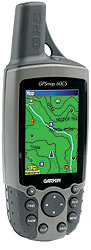
Last month I bought a GPS unit (a Garmin GPSmap 60CS) so that I can geoencode photos. For example, clicking on the photo in this post brings up a page with data about the image, including a satellite map with the location marked. And the photo in this other recent post has the speed and bearing shown as well.
The GPSmap 60CS is a nice unit. It has a lot of functions (including a magnetic compass and a barometric altimeter), but after using it for a while I do have some gripes that I'd like to mention, in the hopes that someone can point out how to overcome these negative points.
The first and perhaps foremost gripe is that its manual is atrocious. It glosses over many features that seem to be important, so I really don't know exactly how to use them. I mentioned a few specific issues in a post when I first got it, but that list has pretty much extended to every function on the thing. A better manual may well solve all the grips that follow....
Barometric Altimeter
It has a barometer, ostensibly used for calculating your altitude accurately (“barometric altimeter”), even when GPS reception is bad (and even when it's good, since GPS in this part of the world is accurate only down to about 6-10 meters).
When I first read about it, I couldn't imagine how it could work, since various different things affect the air pressure. Besides altitude change, other influences include moving quickly (increases pressure on the leading side of the unit, decreases on the trailing side), and oh, yes, changing weather. I must be ignorant, I thought, because if I'm correct, the altimeter would be useless.
Unfortunately, I seem to be correct, as it was essentially useless.
Of course, it was understandably useless in the pressurized airplane, and so the whole time we were at 41,000 feet it said we were at about 7,800 feet. I can't blame it for that, but I can blame it for not letting me select the GPS-calculated altitude rather than the altimeter-calculated one. If I navigated to a specific menu item on the unit, it tells me the GPS-calculated altitude, but if I want to see it again, I have to navigate to that menu item again. It does not log the GPS-calculated altitude in the tracks, and so it's not available for my photo geoencoding. (The altitude data in the Anthony-sleeping-on-the-flight post was fixed by hand.)
Anyway, we got to a beach (the photo in the first post mentioned above), and as you can see, it says we were at 11 meters altitude, when we were actually at about two meters above sea level (one meter at ground level, but I was holding it another three feet above). I went down to the water line and calibrated it to “a known altitude” (zero meters), but half an hour later back in town, it says that we're 20 meters below sea level (which we most certainly weren't)!
Another time, I calibrated it on a beach and stayed there, but a few hours later at that same location it said that we were at 8 meters altitude. Just worthless.
[UPDATE: update on the barometer ]
Other Issues
While looking at its built-in map and moving around a little pointer, there's apparently no way to say “I want to navigate to here”. (That is, you can initiate automatic guidance to that location.) I found this extremely frustrating.
While looking at a track map (the map showing where you've been), there's apparently no way to find out when you were at a specific point on the route. I want to move the little arrow to the little dotted line showing where I've been, and have it tell me when I was there (and, for that matter, the altitude as best it knows it, my speed, etc.) I wanted this feature numerous times while driving around Penang Island, so that I could figure out whether the point on the route I think I'm looking at really is the place we had dinner last night. Very frustrating.
When I download the track log (the log of all the places I'd been with it) to my computer, most points come up twice, once with the timestamp associated with it, and once without. Why? (I think it might have something to do with the difference between a “saved track” and the “track log”, but I really don't know -- the manual says nothing about this whatsoever. In any case, it really makes no sense to deliberately remove the timestamp from the data.)
There are plenty more, but these are the ones I can remember offhand.
Other Comments
When it's trying to acquire the GPS satellite signals, it displays a very nice looking page which graphically shows where the satellites are in my local sky, and what kind of signal is being received from each. It has room to show the signal strength from up to 12 satellites, but it can calculate your position from as little as three.
The most I ever saw was on the drive from Kuala Lumpur city to its airport. I held the unit outside the window of the cab, and it has a strong single from 11 satellites. It said that the accuracy of my location was +/- 6 meters. The next day, on the drive from Kansai airport to Kyoto, inside the car (up against the window) I had reception of a maybe four or five satellites, but an accuracy of +/- 4 meters (the best I've ever seen). Go figure.
One feature I think would be cool, although I doubt I'd ever find a use for it, would be a triangulation feature. You'd sight a distant object (e.g. mountain peak) and press a button, then move some appreciable distance to the side, then sight again. It would then be able to tell you the distance to the object. I think that'd be cool.
Anyway, I like the unit, but the worthless altimeter is a serious bummer. If anyone knows how to turn it off so that the unit uses only the GPS-calculated altitude, I'd love to hear about it.
[Update: it can't be done ]
[Update: I've replaced this unit with a Garmin eTrex Legend HCx ]

Processing some pre-cold, pre-trip photos, I came across this little gem of a sign in an eyeglasses shop in Yamashina, Kyoto, Japan, which I took while stopping by with a friend who was getting an eye exam.
It may be a bit hard to read due to the reflections, but it says:
A professional art-raising the quality and
controlling the price.Unique ideas and
techniques made impossible things possible.
For the sake of irreplaceable persons, we'll dramatize a specially preserved extravagance.
I couldn't have said it better myself! 