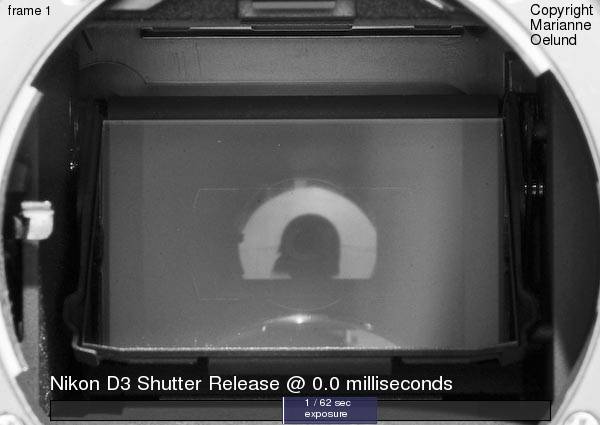
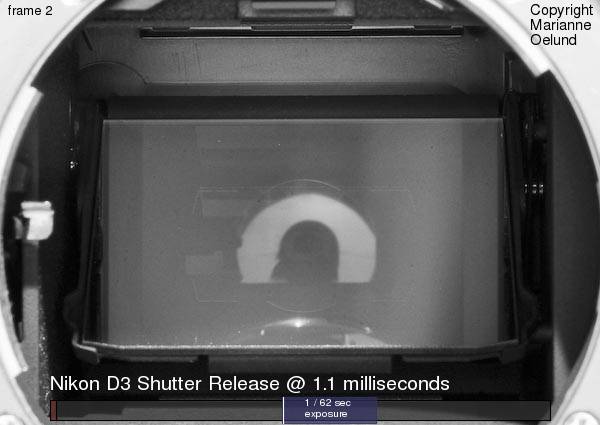
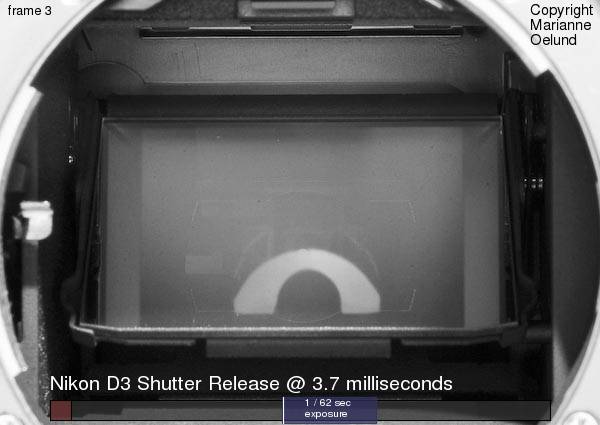
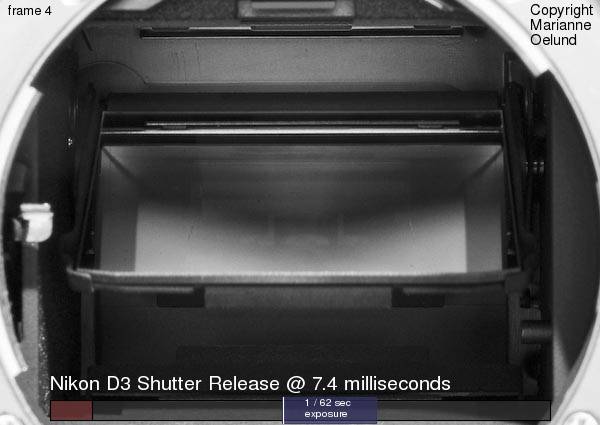
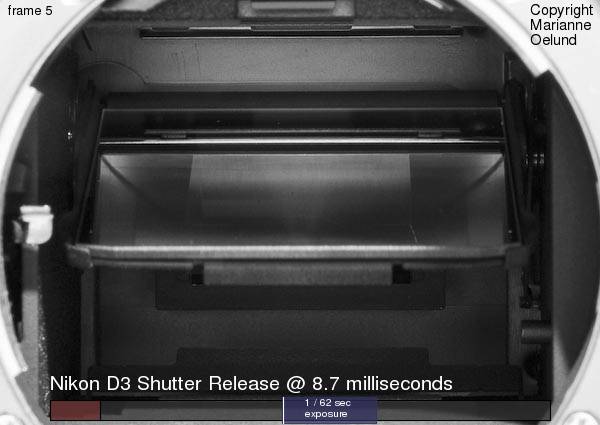
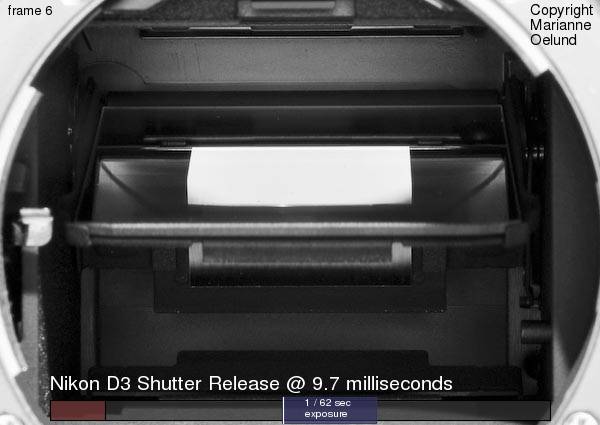
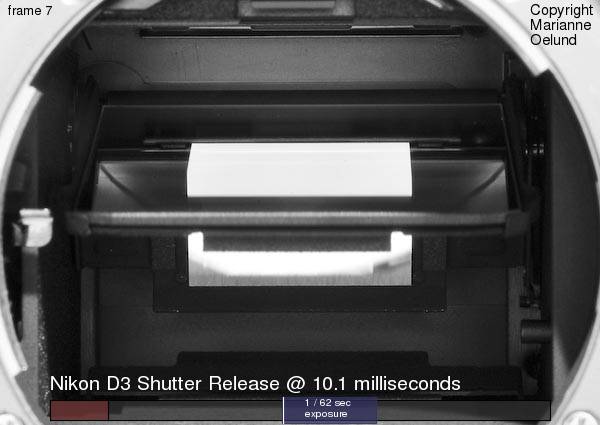
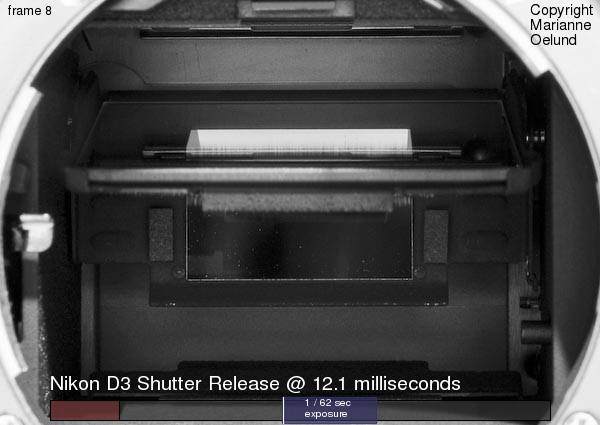
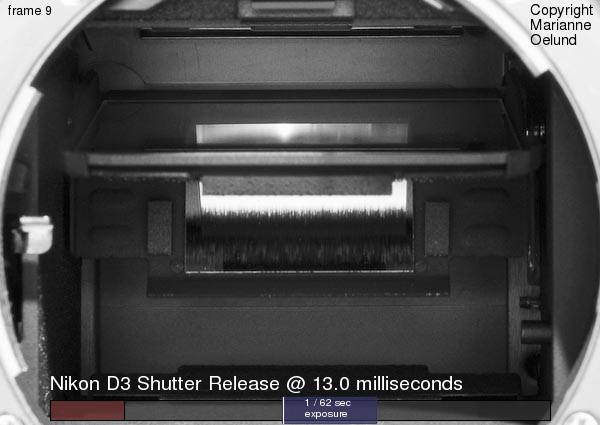
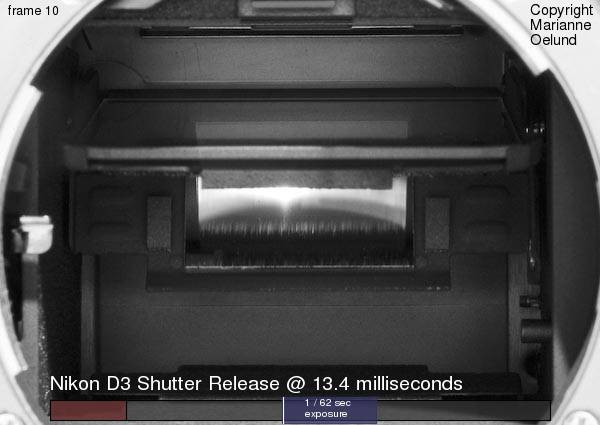
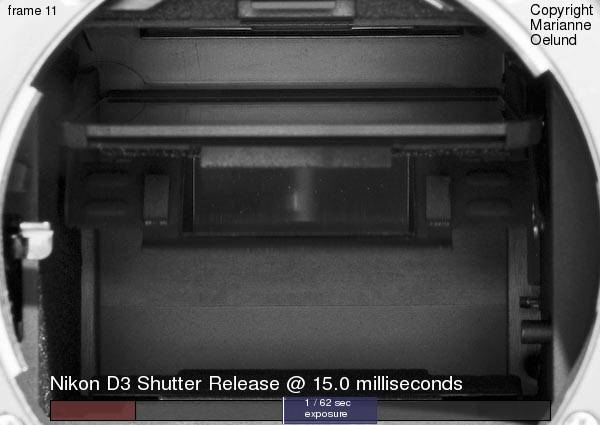
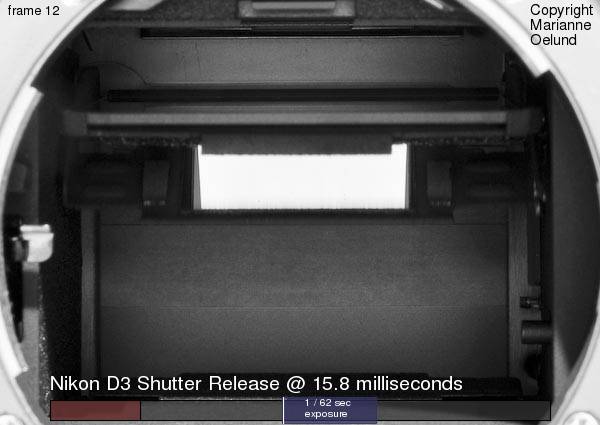
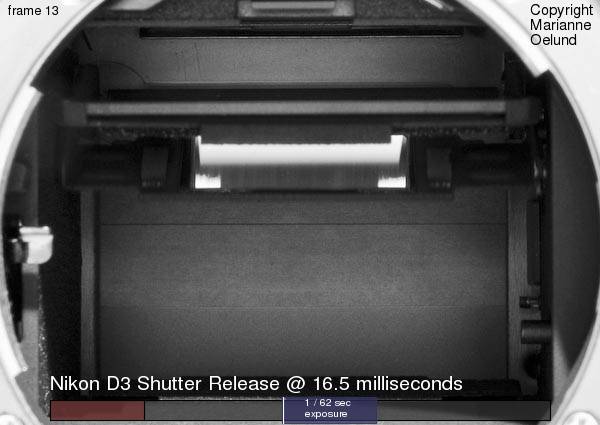
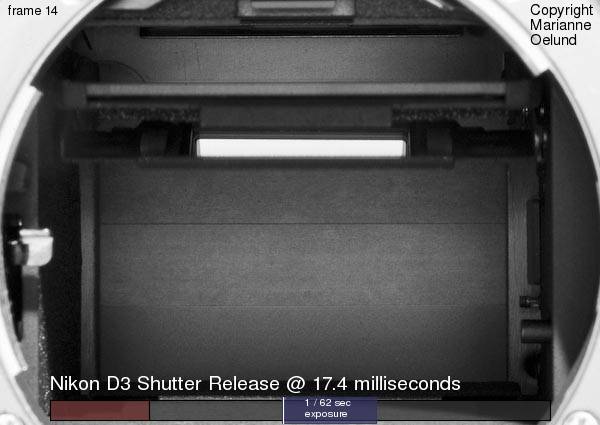
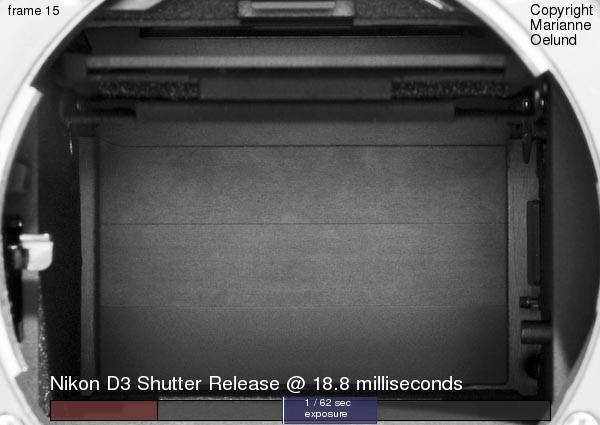
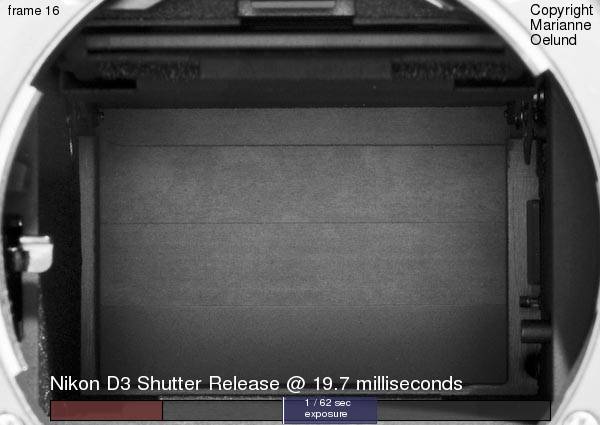
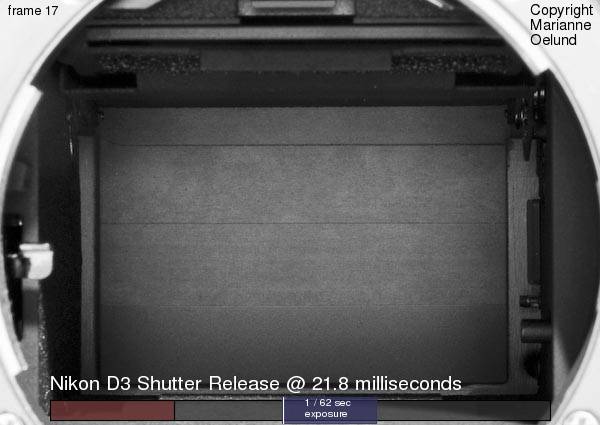
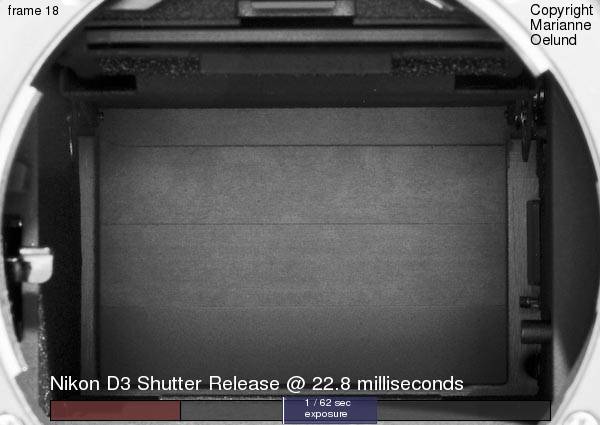
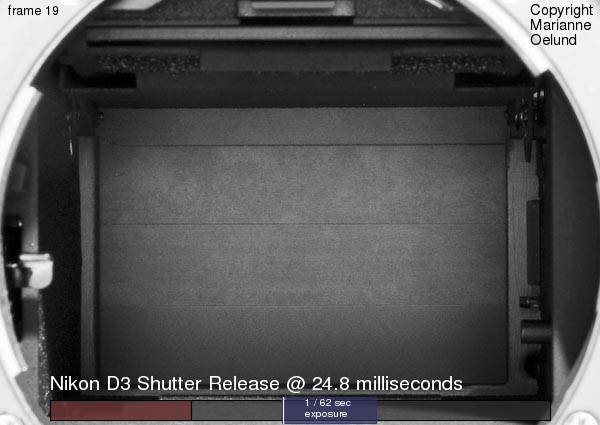
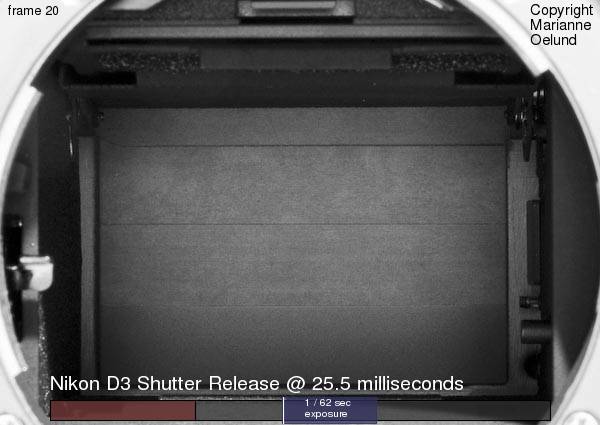
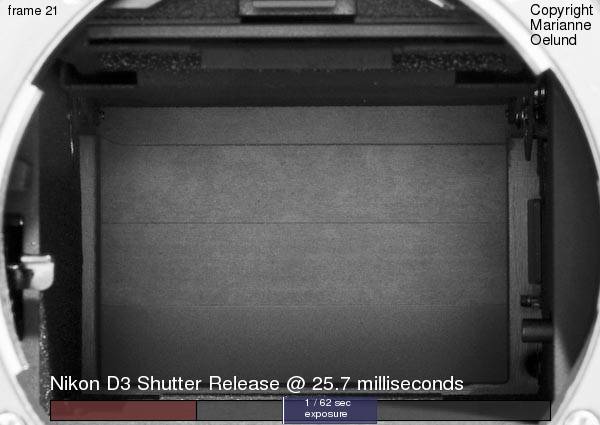
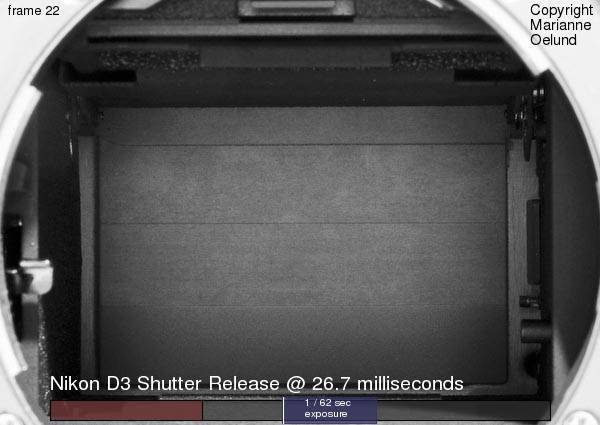
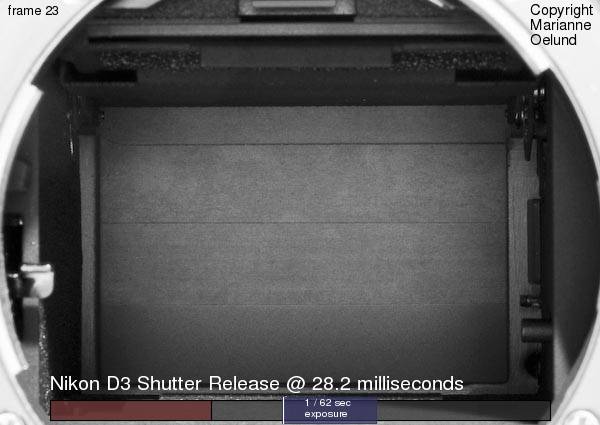
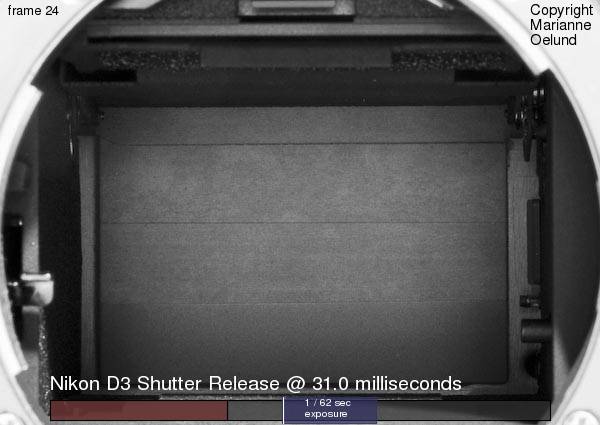
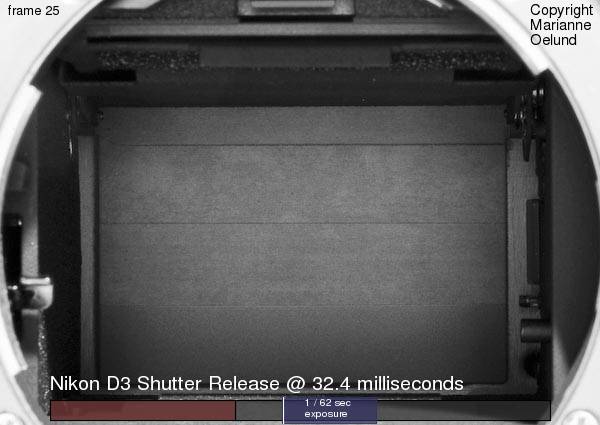
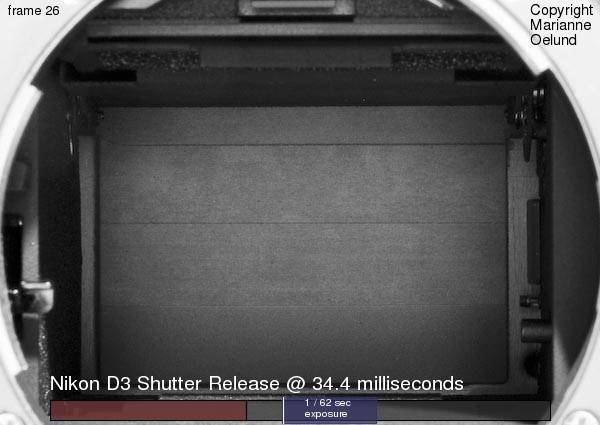
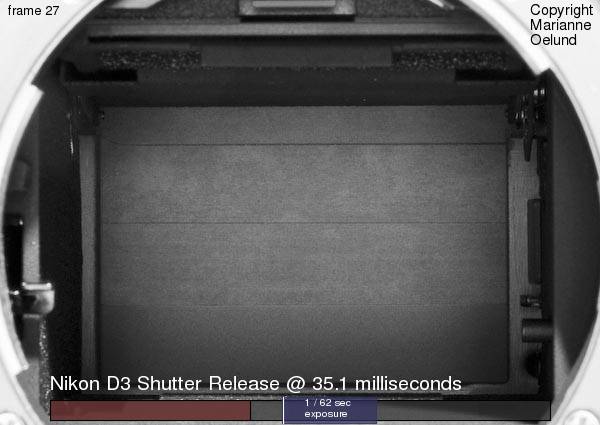
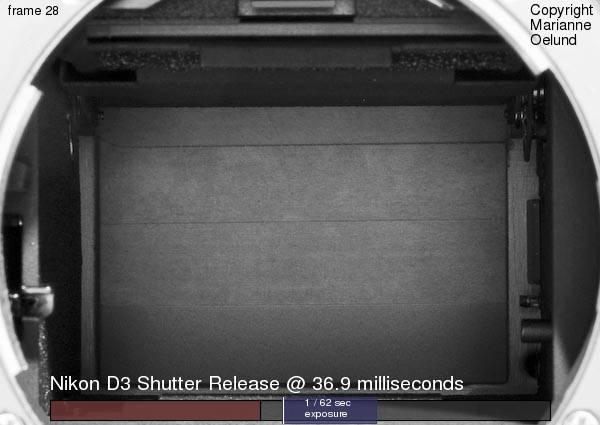
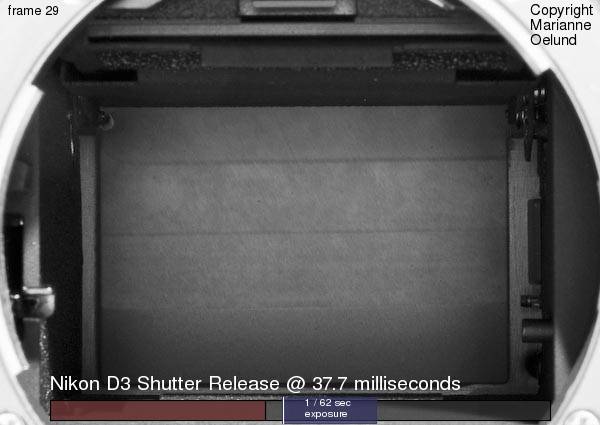
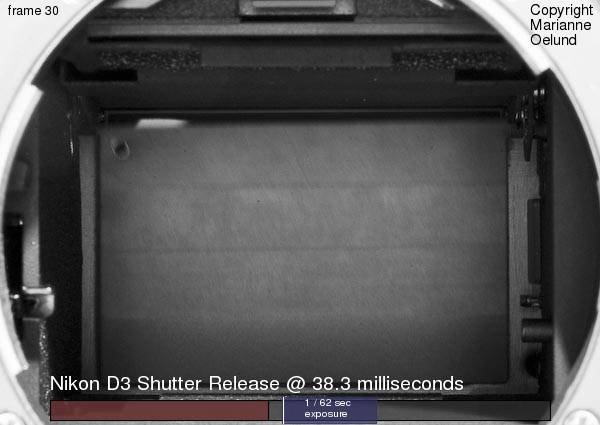
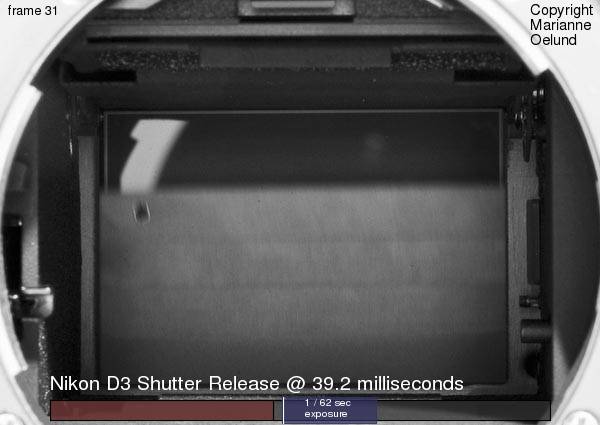
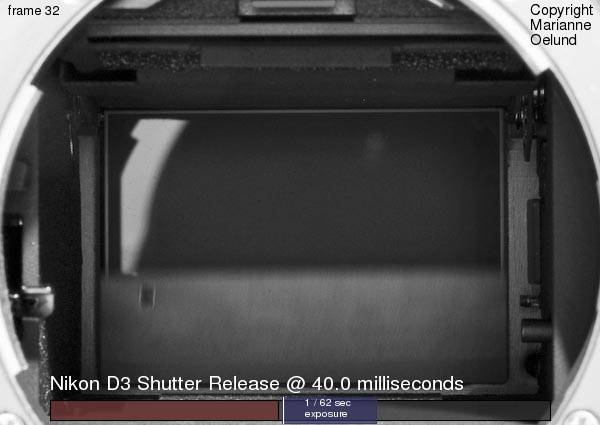
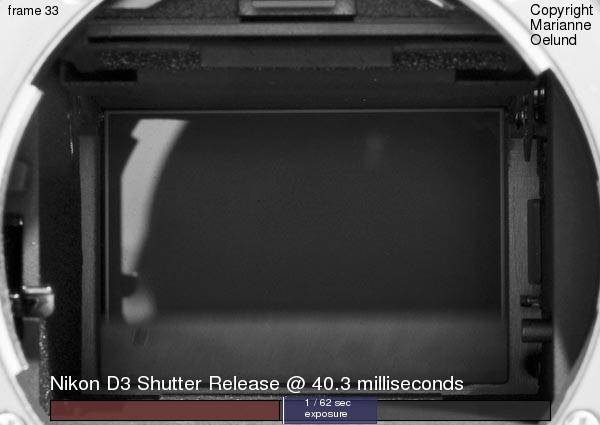
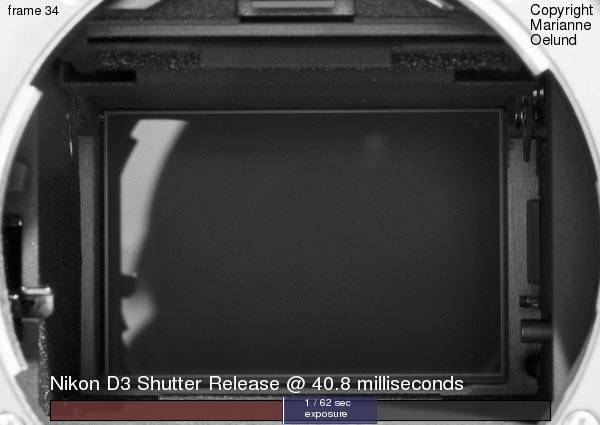
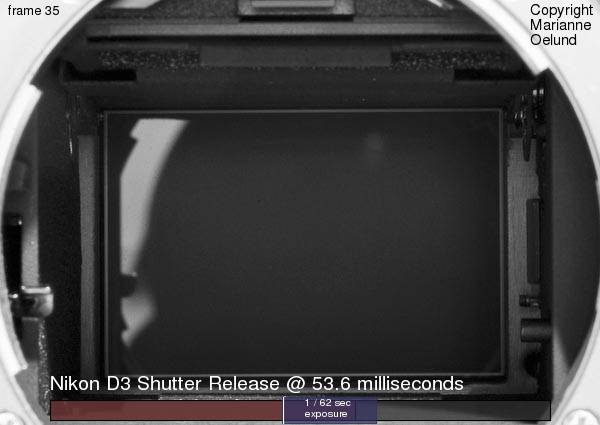
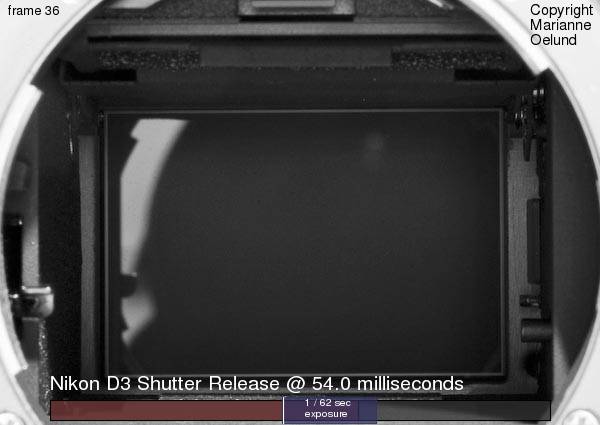
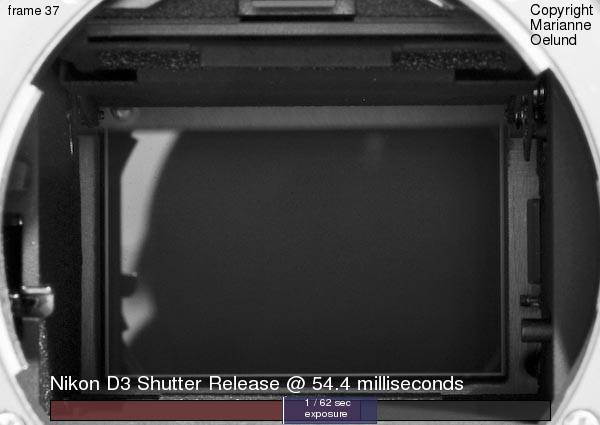
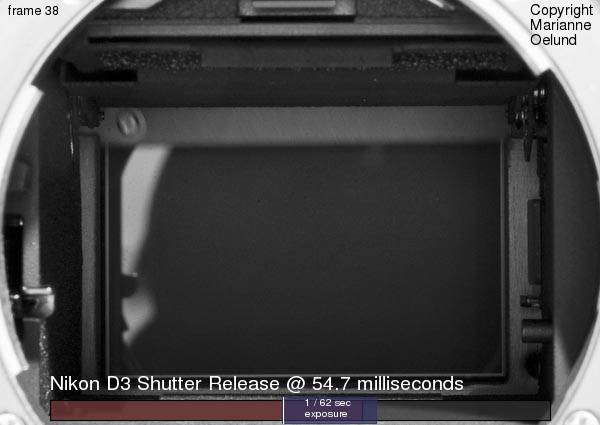
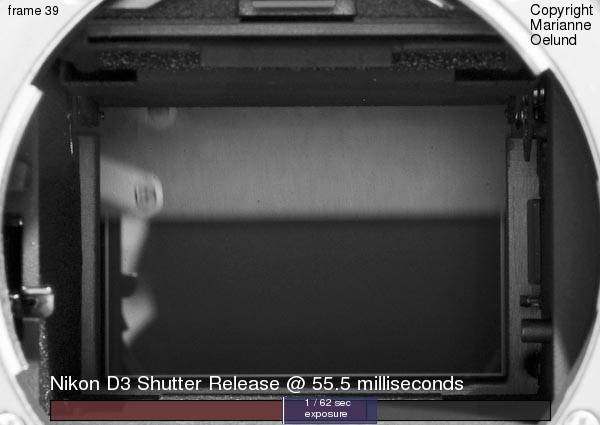
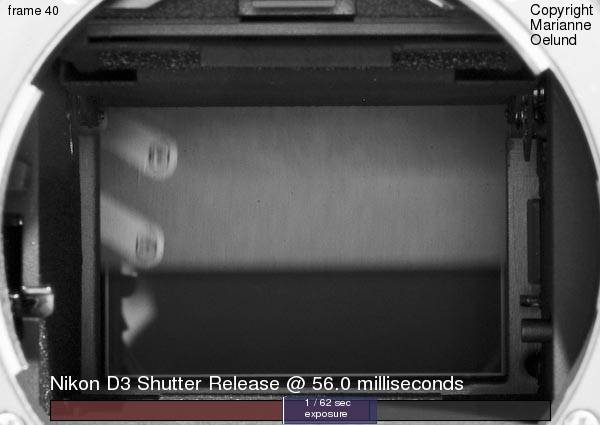
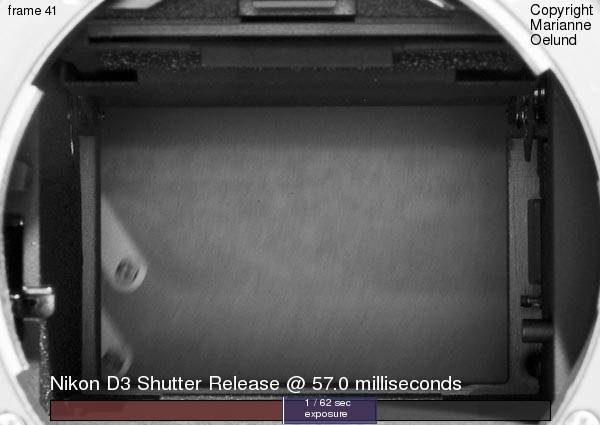
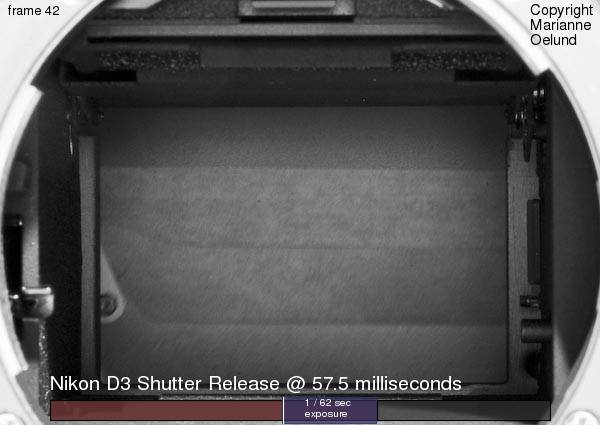
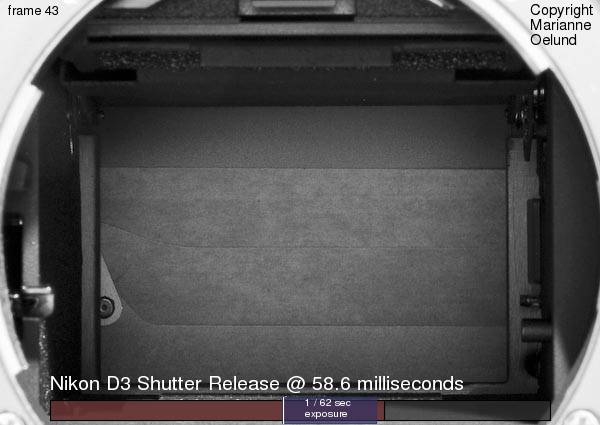
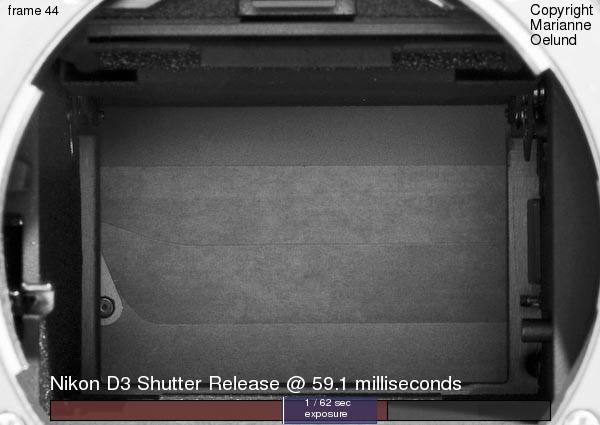
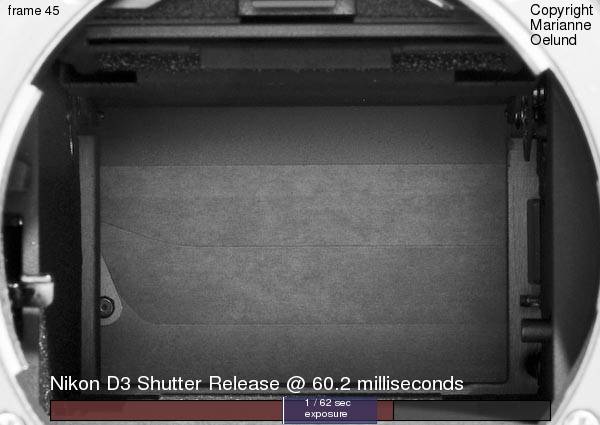
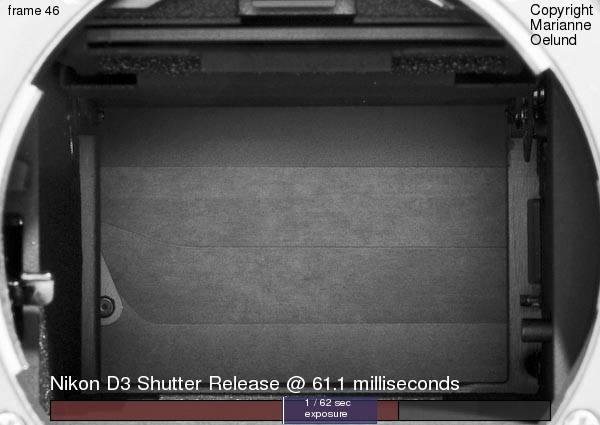
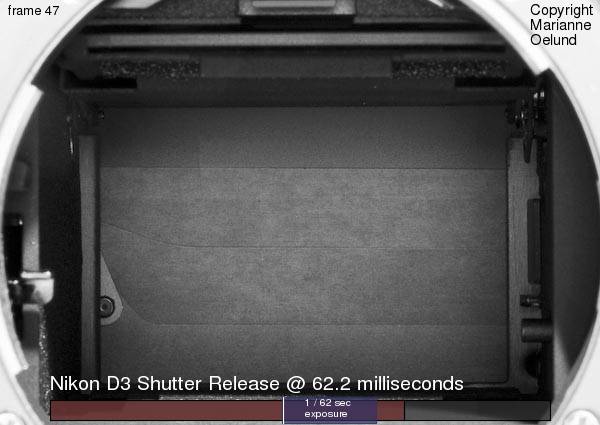
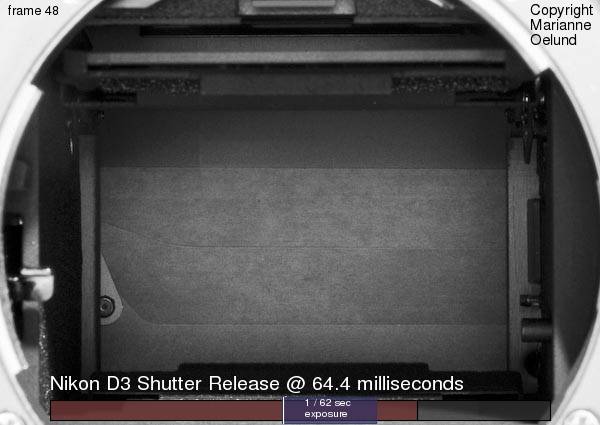
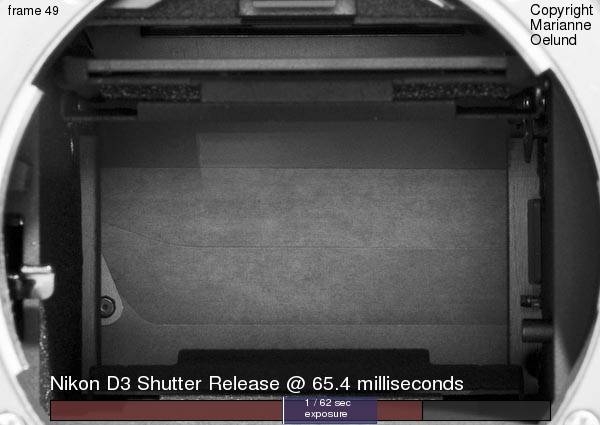
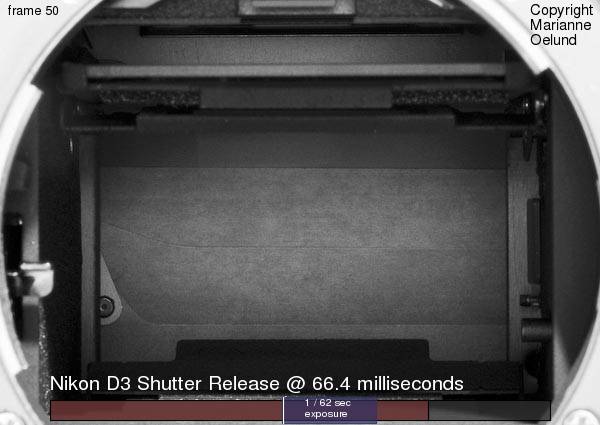
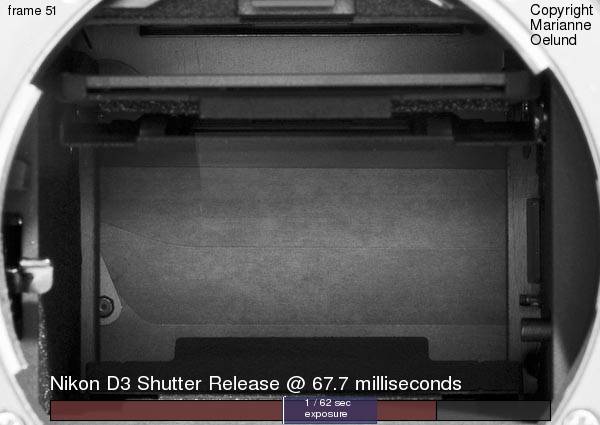
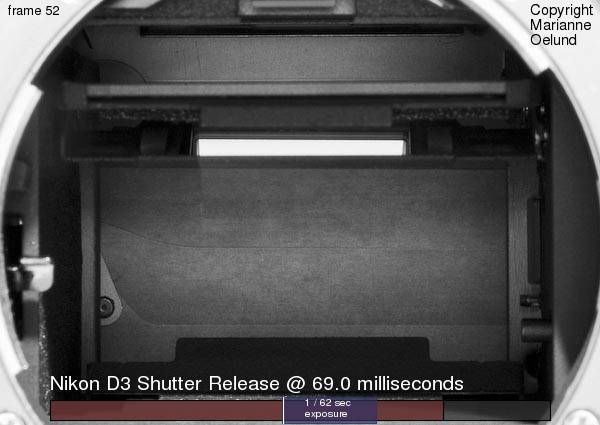
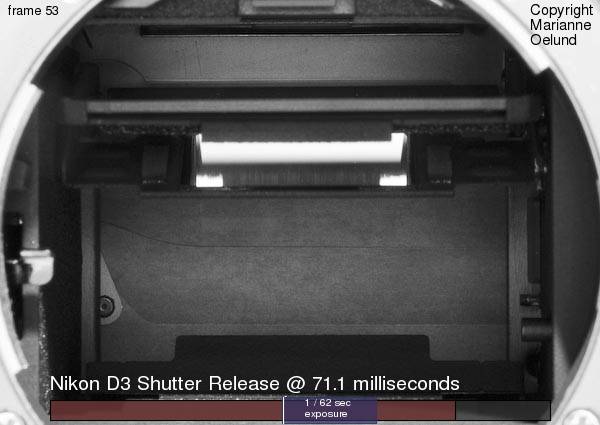
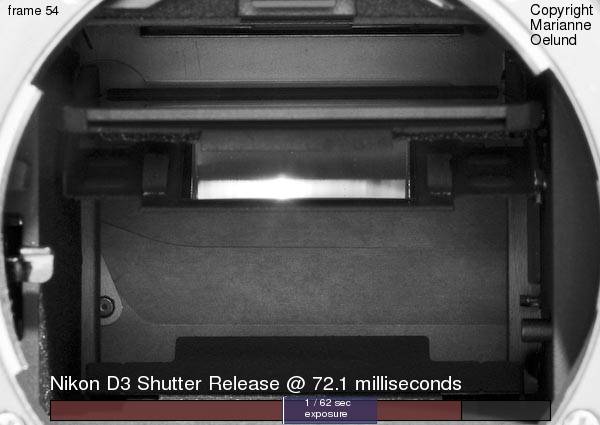
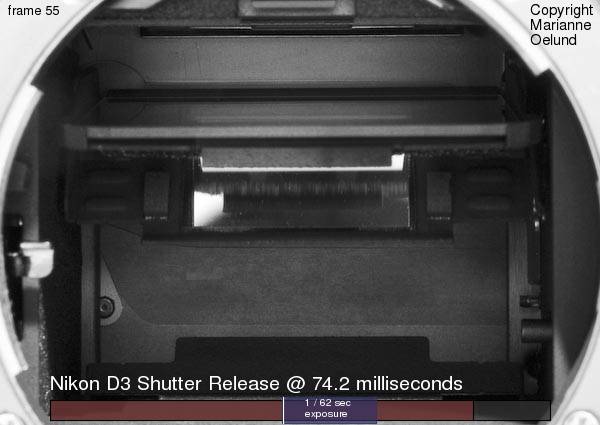
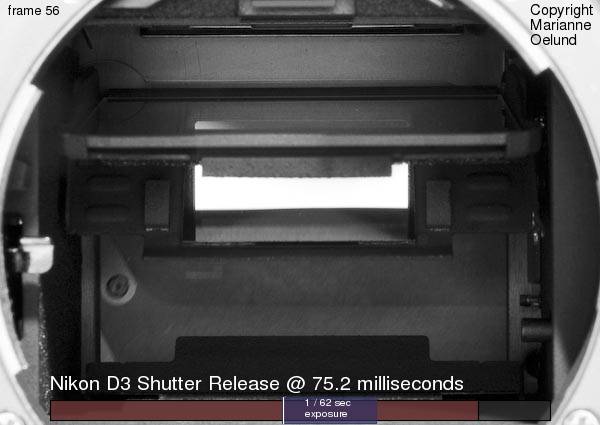
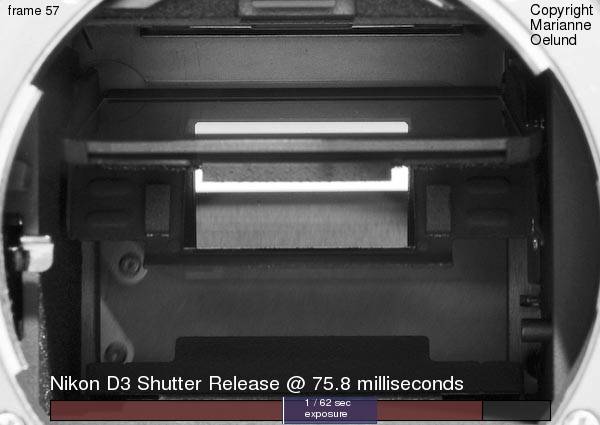
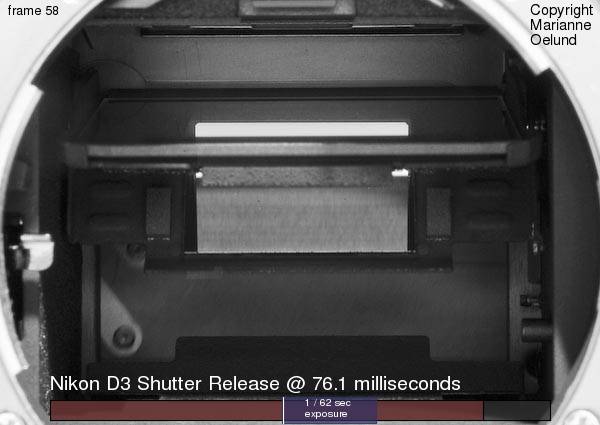
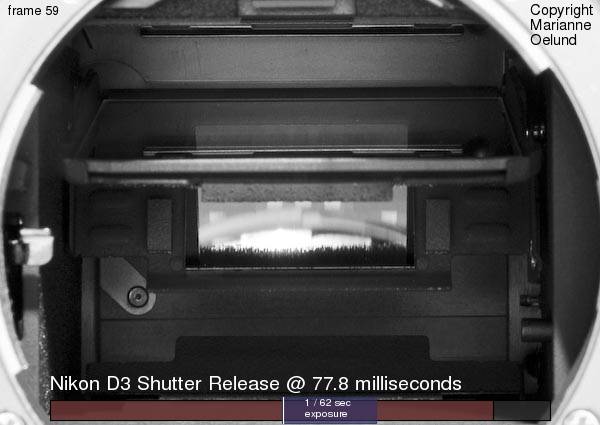
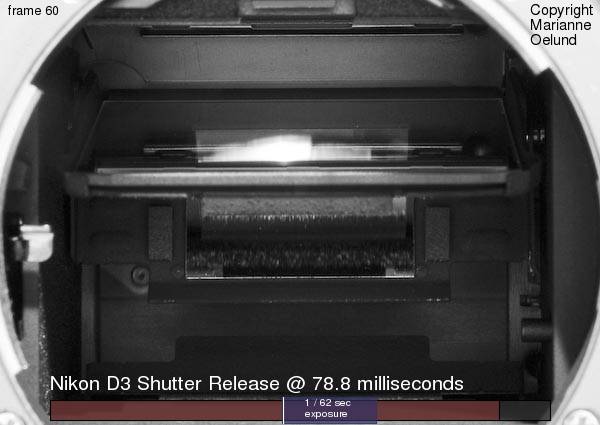
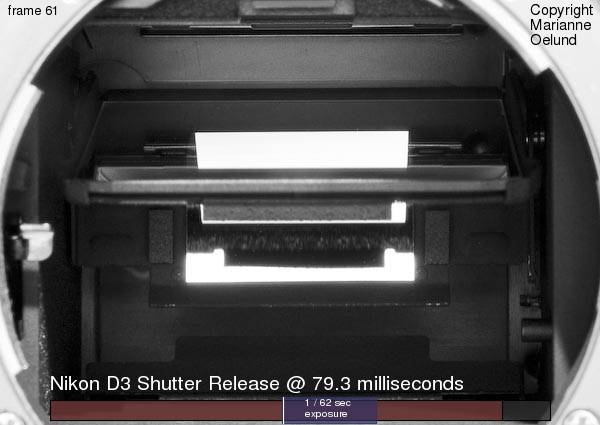
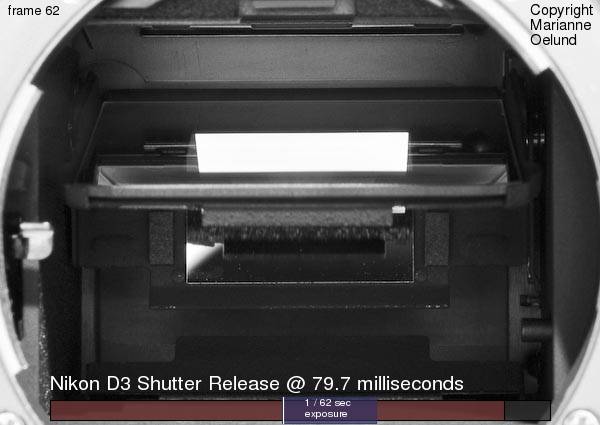
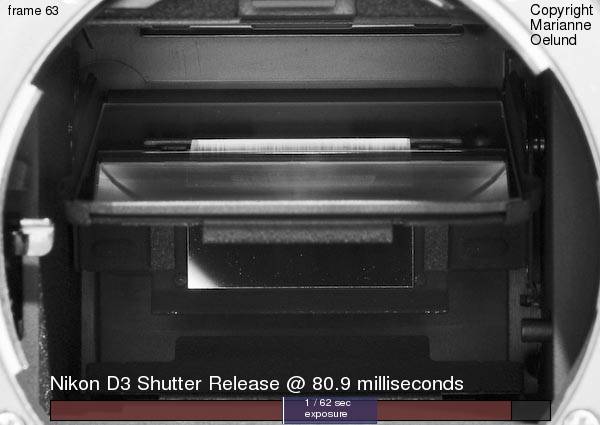
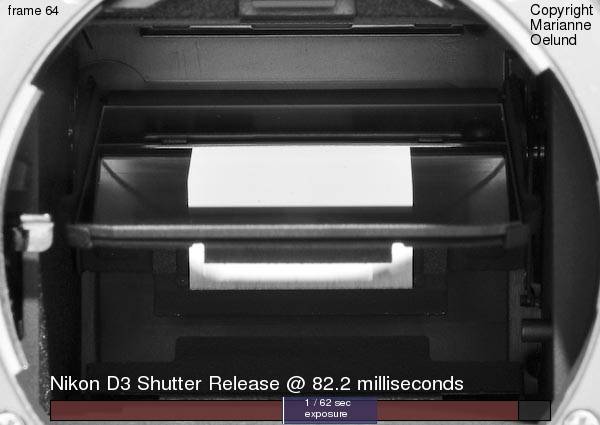
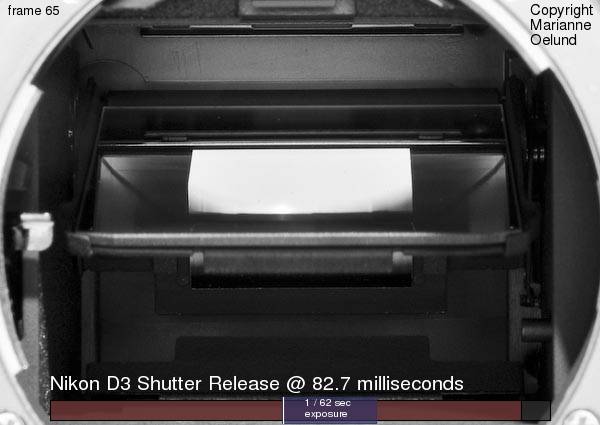
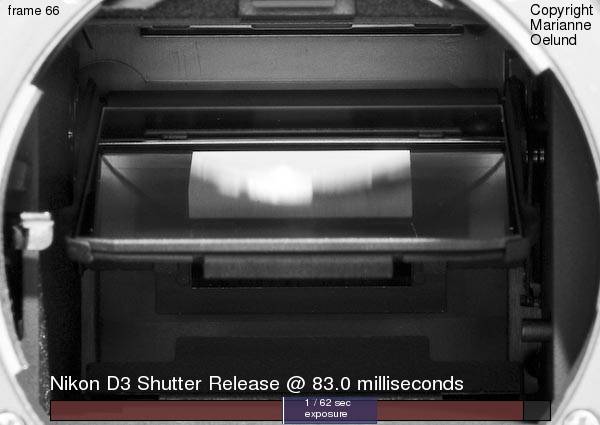
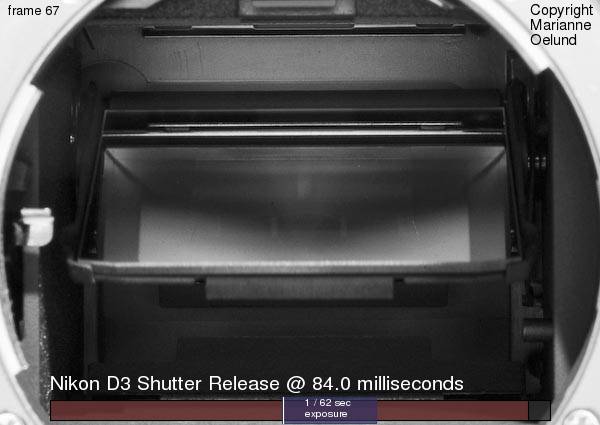
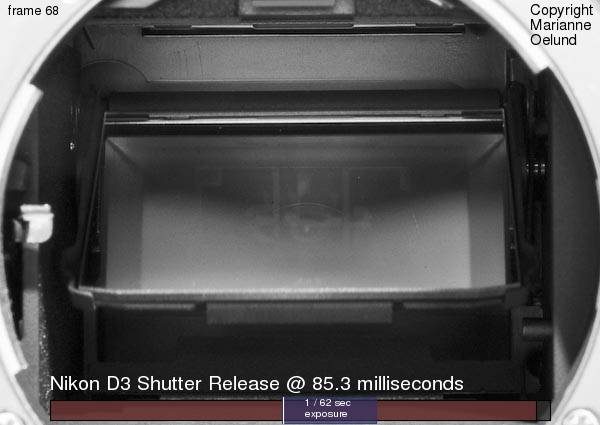
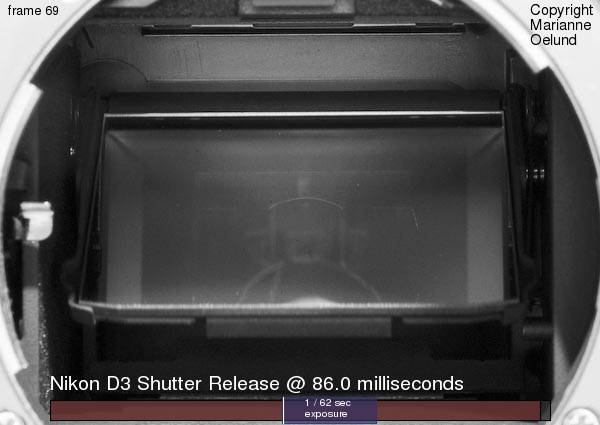
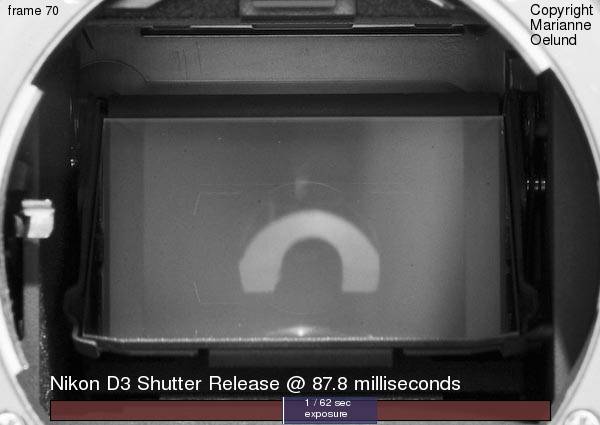
(The white line on the left side of the blue “exposure” band, below the big “@”, is when the camera's flash fired for the exposure.)
Marianne Oelund recently posted a sequence of images of a Nikon D3 shutter in action, over on the Digital Photography Review Nikon D3 forum. With her permission, I have turned that sequence into a mini web movie application, such that you can animate the frames by sliding your mouse back and forth across the image.
I thought she had created the images with a high-speed camera, but it turns out that, lacking a high-speed camera, she went to great (and ingenious) lengths to create this sequence. In her own words:
The setup used to create the images was rather simple; anyone with basic macro equipment could do the same. It just requires quite a bit of patience! I took a total of about 200 frames, and selected 70 for the slides.
The imaging camera was another D3 (but any camera could be used), with a Micro 60mm lens, a white reflective collar around the lens, and a downward-firing SB-900 mounted above. Cable releases were used on both cameras, to avoid disturbing their positions.
What wasn't quite as straightforward, was collecting the timing data. This is the area where a little engineering knowledge and equipment comes in. The “subject” D3 camera had an SB-800 mounted, set to manual 1/128th power, and turned toward the rear. A phototransistor detected this flash pulse, which was captured on an oscilloscope. Another phototransistor was used to sense the imaging camera's flash pulse, then the 'scope could give the precise time delay between the two.
From the timing data, one can calculate the mechanical velocities, and even accelerations. It's worth doing this, as the numbers are impressive, to say the least!
My Tech-Related Photography Posts
- My Lightroom-to-iPad Workflow
- Lightroom Goodies (lots of plugins)
- Digital Image Color Spaces
- Online Exif (Image Data) Viewer
- Jeffrey's Autofocus Test Chart
- Photoshop Calendar-Template-Building Script
- How to Prepare Photos for an iPad
- A Qualitative Analysis of NEF Compression
- Tripod Stability Tests
more...
I love this kind of ingenuity! A high-speed camera would have been so much easier, but hey, if you don't have one, but do have an oscilloscope and a couple of phototransistors (and the knowledge and patience to use them), Marianne shows you can get great results.
I took Marianne's 70 images, converted them to grayscale, cropped and shrunk them, added the various annotations you see on them, and wrapped them all up in a mini web application similar to the Kyoto cherry-blossom timelapse that I posted in the spring.
In looking at the actual shutter (between the mirror and the sensor), it seems that it takes about 3 milliseconds to drop the 26 or so millimeters it needs to expose the sensor. That works out to an average speed of about 8.7 meters/second, or just over 19mph. That's a lot of speed to accelerate to and from so quickly. Wow. Marianne has more timing analysis in her dpreview thread.
If you'd like to know more about how a shutter works (and, in particular, why the shutter design and operation has such an impact on how flash photography can be done), see Derek Miller's excellent writeup on the topic, linked from my “Flash Sync Speed and Other Mysteries“ post.
(The individual frames for my version of the movie above are hosted at Flickr to reduce load on my server.)
This is great Jeffrey- Thanks to you and Marianna….
This is an awesome, amazing post. I really enjoyed playing with that and seeing how it works. Thanks Jeffrey.
This is pretty awesome, thanks to her and to you for posting this. I always wondered how an even exposure was maintained using a single curtain (surely the shutter dropping and returning up would create a image brighter at the top) but now I see two curtains 🙂 How silly of me! I think it’s impressive how fast the mirror is flipped up before the shot is taken – roughly 37ms which is right for the D3 – good to see how this actually happens.
Wow, what a great way of showing an animation. It would sure be great if more online animations were done that way (e.g. those at Wikipedia).
It’s subtle, but as the mirror returns you can also see the shutter resetting itself.
Incredibly effective way of presenting this information. Great ideas, both of you. I’ve always wondered where that sub-mirror (AF, metering) goes. Ingenious!
Great work. Just curious, how are you creating the code to make the image change as you mouse over it?
By typing it 🙂 —Jeffrey
I’ve created something similar here: http://pixelcity.com/skim/
Now I would like to see how my old Nikon FE does the same thing .. and how Canon approaches the same problem.
It’s facinating to see how fast the mirror bounces to a hold between frames 17 and 24 (9.2 milliseconds) and how the sub-mirror seems to help with this.
This is great, thanks for posting it.
I cleaned your sensor while watching this, I hope you don’t mind? 🙂
great animation. I was doing timelaps photo animations for a while, but only the way that shows long process in short time. always wanted to be able to do it other way, to show short event in a long time. thanks for the method description. it may be usefull somehow before I’ll put my hands on some high framerate camera 🙂
if you’re into timelaps animation – please visit my website: http://www.stopmotionlog.com
That is amazing
Great and instructive, I’ll show this to my students to make them understand shutters.
It would have been great to have the animation on a shutter speed above the cameras (D3) flash-sync speed. As this would allow to show why strobes only partially expose the frame at shutter speeds that are too fast.
Thanks again!
Very cool indeed. I now have a lot more respect for my D300!
That was very impressing! Great work by Jeffrey and even greater by Marianne! Very instructive. You guys have a lot of spare time apparently!
Very nice, thank you…
This is awesome, what ingenuity. I love the D3, but I just can’t get myself to change from my 5D and Mk III.
Nice one! 🙂
[Although I’m a canon user]
Absolutely fascinating!
Thank you very much for posting such a thing!
And please keep sequences like this comming!
It”s fantastic!
Very nice 😉
Wow, great work explaining how the shutter works. I’m assuming you had to take numerous shots and select only the ones that create a “flow” of the whole action. How did you freeze the motion in “mid air” of the curtains?
It’s noticeable that there is something on the left that moves in the opposite direction to the mirror. I suspect this is associated with some form of counterweight. The law of conservation of angular momentum dictates that as the mirror is accelerated upwards on it’s access, there will be a counter-reaction which will act to rotate the camera body and lens downwards. When the mirror hits the buffers at the top of it’s travel, then the reverse will happen and the downward motion of the lens/camera would be halted. However, the such an action will almost inevitably cause some form of oscillation, even where the camera is mounted to a sturdy tripod. Even though the mirror is much lighter than the camera/lens combination, with a heavy FF mirror, and the necessary very fast acceleration to cope with a 10+ FPS camera, the effect will be noticeable (one of the reasons that mirror lock-up was invented). Also stopping such a heavy, fast moving item smoothly without some bounce is difficult.
One excellent way of counteracting this is to have a counterweight moving in the opposite direction in order to cancel out the angular momentum caused by the mirror movement. By using suitable cams it also ought to be possible to accelerate and decelerate the mirror assembly smoothly. I suspect that the device seen on the left is part of such a mechanism.
Steve Jones wrote:
“…By using suitable cams it also ought to be possible to accelerate and decelerate the mirror assembly smoothly. I suspect that the device seen on the left is part of such a mechanism.”
Hey Steve,
I believe it is just the mechanical arm to actuate the aperture! I don’t know much about Nikon cameras though!
~nathan
Further thought. If it is the actuator for the aperture, it would be a good counter weight because automatic apertures always return to an original position, wide open. I have taken a few lenses apart in my short day, and have broken springs that pull the aperture back open. A good possibility?
~nathan
Sorry for the late comment, but I was directed here today from a post at DPS. Great visual explanation of what happens when we press that little button!
One minor point I thought I’d bring to your attention, though. Before the exposure and continuing through its duration, you refer to the first shutter we see as the “front shutter” and the second one as the “rear shutter.” When this second shutter returns, you switch and call it the “front shutter.”
I think you got it right at the end. The shutter that drops out of the way at the beginning of the exposure is actually the rear shutter, which is why we don’t see it return after the exposure. The second shutter is actually in front, hiding the other shutter until it returns at the end.
Not that it makes a whole heckuva lot of difference, but being the anal retentive type, I thought I’d point that out to you.
Again, great job, and thanks!
Great job!
Incredible! Thank you so much for posting this.
It is amazing seeing the action of what many had been wondering how it works ‘Camera Shutter’ with 3D. with the above breake down one need not ask much ambiguious question of how a clear Photograph come to be.
My curiosity about Digital Cameras are gradually taking shape. I like what I saw.
please Keep up the good work. I am impressed.
Well I am Grphic Designer, from Nigeria.
I can not do without a digital Cameras in my profession. I am relief being elittened.
A. Paschal
Nigeria
How complicated is that. It should last aprox. 250K shots. It is amazing how delicate it all looks.
Wonderful! Love your creativity.
Followed here from our LSM lens perspective discussion on Flickr, via these frames hosted on your account there. It turns out I linked to this page some time ago from a similar effort of mine. Your and Marianne’s presentation is much nicer though!
I love these super slow motion videos from Japan
http://www.japansugoi.com/wordpress/the-world-of-super-slow-motion-camera/
Hello Jeffrey,
How can I download Marianne’s and your shutter animation? I’ve asked Marianne and have her permission to use it in my workshops. I have no excess for internet at my workshop location so I can’t show it using your site.
Greetings Nick Zweers
My animation is done in the browser… it’s not a video. Just view the animation in the browser, then don’t close the browser before class. It’ll be in your cache, so you can continue to interact without Internet access. —Jeffrey
As mentioned here
http://regex.info/blog/2008-09-04/925#comment-34610
by Boyd (forgive me, I’m rusty on my HTML tags), the labeling of the shutters is a bit incongruous. The curtain you (at first) call the “front shutter” which is physically the rear curtain, drops first, and returns first. Makes sense to me. Sort of. Aside from the whole physically-being-in-rear thing. Still, it’s the “front curtain” by conventional standards, with respect to the timing of its movement, and the names used for flash sync. That’s fine, and makes perfect sense. The only problem is that you switch the naming around between when it drops, and when it returns. The same applies to the one you at first call the “rear shutter,” which is physically in front.
When the shutters are opening, you use the names that refer to the order in which they open, but when they close, you use the names that refer to their physical position.
Sorry, I’m just being picky… I dug this out of my bookmarks from a year or two ago, so I could recommend this to one of my photography instructors, to help him explain shutters and SLRs to future classes, particularly since the front and rear curtain concepts really confused my classmates, and consistently confuses everyone else I know, but I don’t want to confuse people even more with inconsistencies.
If only Nikon had just made things less confusing by having the curtain that moves at the “front end” of the exposure be physically “in front,” and vise-versa. Then again, who’s to say it isn’t already physically “in front,” and this naming system was meant for people looking at it from a side of the shutter that only the designers and camera techs get to see anymore? I miss the days of film, where you could really see how things worked. Cameras like the F6 are just too expensive anymore!
Just a thank you note, this. I am Skanda, from Bangalore, India.
I stumbled upon this jewel of a presentation when I was looking for a better understanding of the shutter mechanism, and I must say I am blown off my feet!! It is stunning to see how ingenious application of thought can produce this work, and of course, I’m extremely grateful to you for putting in the substantial effort it must have taken, both creative and laborious, in order to present it this way. Thank you very much!!