I introduced my tripod stability tests in the previous post, and I'll continue in this post with more details.
Before I continue, I must note that there are some serious caveats that limit how much one can really read into the result I'm about to present. I don't list the caveats up front because no one will pay attention to them anyway /-:, so I detail them later in this post.
In this post I'll focus on equipment setup. In another, I focus more on technique.
Equipment Tests: Basics
To test the effects of changing equipment, I used a photo-taking technique that I hoped would give me the best results: I used a remote release so that I didn't actually touch the camera, and I used mirror lock up to raise the camera's mirror, and let it sit for at least 10 seconds before actually tripping the shutter, so as to allow any vibration from the mirror movement to fade away. It's extra work, but should give the best results possible for any given setup.
Here are the results of using that technique with the pro-caliber Gitzo 3540XLS carbon-fiber legs (described here) set up in various ways, with one final “crappy tripod” example using the cheap, flimsy tripod described yesterday.
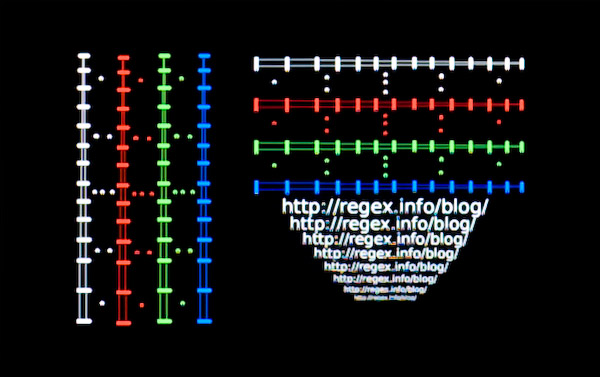
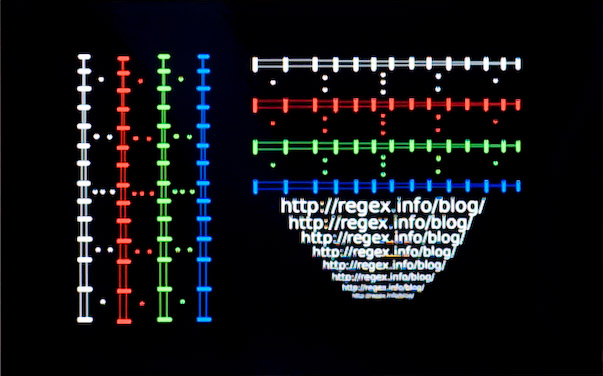

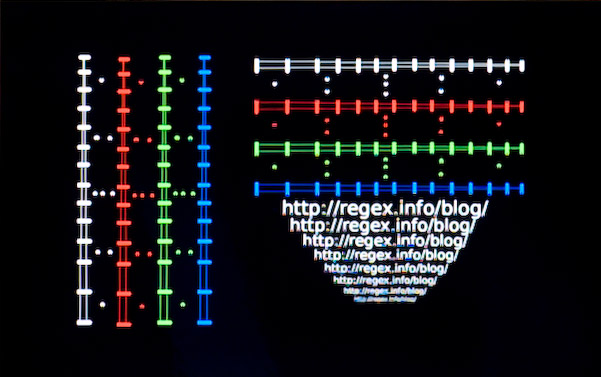
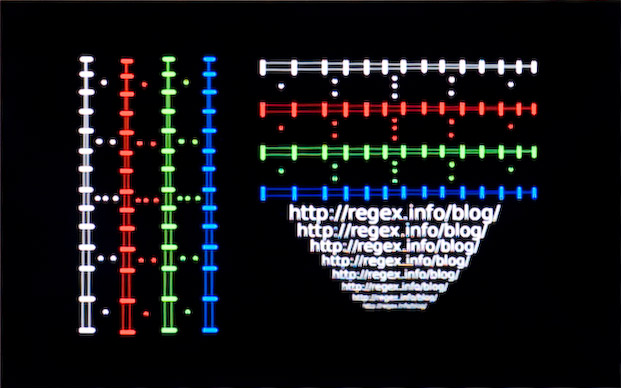
Test Description
The “Ref” image above will be the first image presented in all the sets, and is what I would consider a reference image — the best I could produce with a one-second exposure. It uses the tripod legs without any of the sections extended, and without any center column, ballhead, or other movable camera mount. It's a fairly impractical setup for real-world use due to the lack of a movable mount, but since that lack removes much potential for instability, it should be ideal as a reference setup.
The “+ Ballhead” version adds a pro-caliber ballhead (the Really Right Stuff BH-55, with the Really Right Stuff PLC-1 quick-release clamp, also described here).
For the “+ 3 Legs” version, I extended three of the four leg sections, resulting in a camera about eye height for me. (I'm 6'4“)
For the ”+ 4 Legs" version, I extended all the leg sections. This was much taller than I could normally use, with the camera almost touching the 8-foot ceiling in my living-room.
And again, as an opposite reference, there's the “Crappy Tripod” version.
Test Analysis
The two extremes, “Ref” and “Crappy Tripod” are certainly different, but the Crappy Tripod one is not that bad, indicating that good technique can make up for a lot.
Oddly, the quality seems to get a bit better when moving from “+Ballhead” to “+3 Legs” (that is, by lengthening some of the tripod legs), which is counter-intuitive. This is an excellent example of one of the caveats that I point out later: I was perhaps a bit more sloppy in my tests that I should have been, and because I took only one image at each setup rather than taking several, I lose a bit to a wider margin of error. The difference between these two pictures is pretty small, and so falls into that margin of error, I think.
All in all, there's little practical difference from the “Ref” through “+4 Legs”, which leads me to conclude that good technique and good equipment under ideal circumstances can lead to good results. Under ideal circumstances, you don't lose much stability even when raising the camera up 8 feet on quality legs and a quality ballhead.
Note that the results shown above don't indicate anything about less-than-ideal conditions (e.g. wind, trucks rumbling by) or technique (not using a remote shutter release, for example). The next set of tests attempts to address half of that.
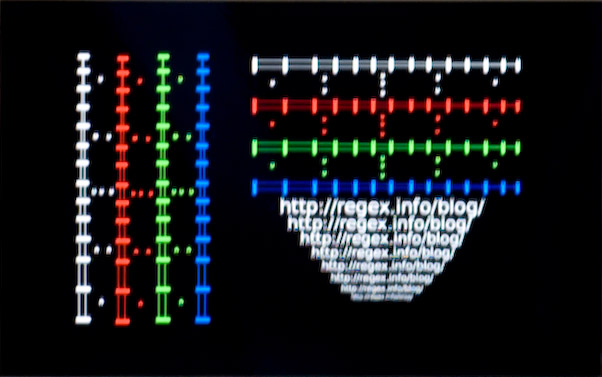
This set has the same equipment configurations, but the picture-taking technique changed from using a remote shutter release, to my pressing the camera's shutter-release button by hand. For these tests, I did the pressing very carefully, controlling my breathing and trying to be as soft and gentle as possible....



Test Analysis
The value of a quality tripod makes itself clear in the “crappy tripod” version, which shows a lot of movement despite my having been very careful.
Relatively speaking, the others look much better and are all in the realm of usable. Still, they've all lost noticeable sharpness from the reference image.
Oddly, the same counter-intuitive difference in the move from “+Ballhead” to “+3 Legs” is also present here. I can think of three possible explanations:
- The “margin for error” just coincidentally manifested itself in the same spot. (Time to play the lottery!)
- Something was wrong when I did the “+Ballhead” tests. (Maybe my refrigerator running full tilt?)
- These results accurately reflect reality, and for some reason, stability is increased when extending the legs. (Seems highly unlikely, but who knows?)
That aside, the results make a lot of sense, getting progressively worse as you move across. The conclusion supports common sense: good technique become more and more important as your equipment gets taller / more complex / lower quality.
Equipment Tests: Center Column
A center column can be really convenient, allowing you to make quick and fine-grained adjustments of camera height. Without a center column, you have to futz with the length of the tripod legs to change he height, which believe me, is not fun. However, it's clear that adding an extra movable component to the support system will weaken it, but does it really matter enough to, well, matter?
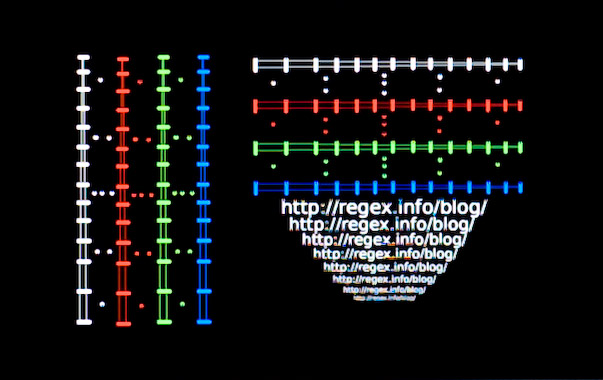
I did some tests with my tripod at its three-leg-section setup, first without a center column, then with the center column installed but completely down, and then at various heights.

Test Description
- Ref — standard reference image
- No Column — three of four leg sections extended, ballhead installed, but no center column.
- Column Down — like above, but with a center column installed and positioned all the way down (its most stable).
- 10cm Up — like above, but with the column extended 10cm (about 4 inches), a likely height to use it at.
- 32cm Up — the center column extended to its maximum of over a foot, its most unstable. This is an extreme height to use a center column at.
Test Analysis
All the configurations yield images that are in the realm of being usable, but there's a clear penalty to raising the center column. Simply having the column installed seems to yield no penalty unless you actually raise it up.
Surprisingly, raising it just a bit seemed to have the same impact as raising it all the way.
With good technique, you can install and use a center column if you need to, but there's indeed some small penalty to actually using the column.
Like so many things in photography and life, it becomes a balance of convenience vs. quality.
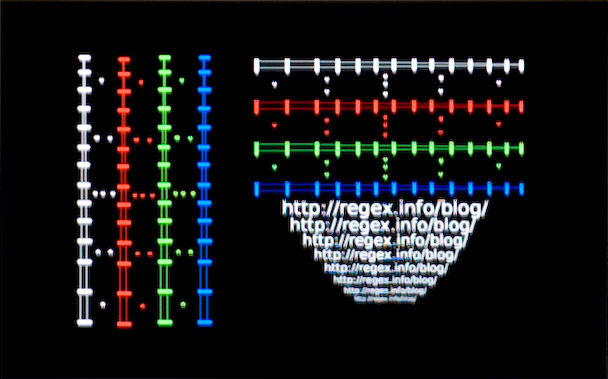
As before, let's see the results now when using a less-good technique (carefully releasing the shutter by hand, rather than using a remote shutter release)....

Test Analysis
The results parallel those in the previous set, but the poor technique amplifies the differences. It now seems apparent that there's a small penalty for just having the column installed. Still, I must reiterate that with a difference as small as we're seeing here, and the long list of caveats yet to be discussed, it's not reasonable to draw any conclusions.
I can't say the same while looking at the “10 cm Up” and “32 cm Up” frames, which show (relatively speaking) considerable shake.
The conclusions here parallel those from before, and basically show the importance of using a remote shutter release with a tripod, or at least not using a center column unless you really need to.... at least not with long exposures with a long zoom lens.
That last “at least...” phrase is important to highlight: the blurring effects of camera shake (whether due to poor technique or inferior equipment) decrease as you use a faster shutter speed and/or less zoom. These tests of one-second exposure at 200mm zoom may well be common in landscape photography (an area I have little experience in), but are unrealistically harsh for many common situations where a one-second exposure would result in blur from subject movement that far exceeded that from the tripod or technique.
So, here are some things that may conspire to make any conclusions I've come up with worthless....
- I should have taken multiple shots in each situation and then picked the best or average result, thereby reducing the chance of a one-time mistake making its way into the results.
- I should have been more careful to ensure my camera was level, so that I wouldn't have had to make minor rotations in the results to get them to look comparable. This greatly increases the margin for error in comparing mostly-sharp results.
- I should have been more careful to ensure that the lens was always at the full 200mm. At one point along the way I noticed that it was a touch below 200mm (190mm?). I hadn't moved so much that the Exif data registered anything but “200mm”, but I should have been more careful nevertheless.
- Since the target was 50+ feet away, I didn't pay strict attention to the exact point I set up the tripod, but in thinking about it now, a difference of just one foot would result in a 2% change in the size of the target, which perhaps has a real effect on how we interpret the results. I should have kept the camera-to-target distance constant (which includes adjusting for the changes in camera level that come with different tripod setups).
- I'm just testing with my own personal equipment, using techniques that I happen to know. The results may not apply at all to your equipment or technique.
- It may well be that the relative effects of changes across different setups is completely different at different shutter speeds. There's no way to know without testing, and I haven't done that (yet?).
- My ballhead is equipped with a Really Right Stuff PLC-1 panoramic quick-release clamp, which may have completely different properties from the more common solid quick-release clamp that I used with the non-ballhead “Ref” images. I really should have taken PLC-1 out of the mix and used a solid quick-release clamp for all the tests (unless I specifically wanted to test the effect of adding the PLC-1 to the list).
- None of the tests measured “3rd-party vibration,” such as that from people walking by, trucks driving by, wind, etc. It may well be that the relative merits among the various situations tested would change considerably when outside forces
are added to the mix.
My Tech-Related Photography Posts
- My Lightroom-to-iPad Workflow
- Lightroom Goodies (lots of plugins)
- Digital Image Color Spaces
- Online Exif (Image Data) Viewer
- Jeffrey's Autofocus Test Chart
- Photoshop Calendar-Template-Building Script
- How to Prepare Photos for an iPad
- A Qualitative Analysis of NEF Compression
- Tripod Stability Tests
more...
- It could be that my house is not a very good platform upon which to conduct tests. I think it should be fine because it's a modern post-Kobe condo built with an abundance of concrete and steel, and the flooring itself has a lot of vibration-dampening built in (that we added as an option while it was being built, as an added measure against the sound of Anthony's running feet bothering the downstairs neighbors). But for all I know, vibration from the fridge or washing machine or birds flying outside make their way to my floor and tripod, and perhaps that happened while I was conducting the tests? I don't know.
- I should have taken more steps to try to increase sharpness, such as
hanging a weight from the center column when one was being used.
Another area for improvement would be to have moved from a 200mm zoom to a prime.
(Re-doing these tests will be the perfect reason to go out and get a
new lens; if someone would like to
contribute this fine lens to the effort, I would be most appreciative
 ).
). - When it comes down to it, I'm not an expert on any of this stuff, so perhaps there are fundamental flaws in my tests or my interpretation of the results.
Although tripod stability not on the top of my list for bedtime reading, it’s really nice to you always seem to be able to spend time on things you enjoy. I wish I could find more time for fun projects…
First: Thank you for this big test. I can imagine how long it takes to get all this things done. But as you want critique on this – here is mine:
Shutter Speed If you have the time, please test at the most sensible shutter speed.
Test Target I don’t like your test target. I don’t like the idea to use a laptop screen. It is a highly unusual target in praxis terms. It has unusual contrast and some sort of blowing highlights. I understand that it is the most simple way to get a test target, but I don’t think it is the best. And you are testing here one of the best possible tripods of the world. So I think you should by some test target or even print something.
To drive a conclusion how much a good tripod contributes to sharpness, it would be good to do some outside tests in a windy environment. I think that than the cheap tripod won’t look so good even with the best technique.
Multiple Shots As you said it yourself. I think this is a must. Taking multiple samples is one basic principle of doing tests.
This reminds me of a high school science fair experiment (in a good way!)
Jeffrey,
Very nice. I have been trying to research to pieces of information that I have heard in several places. 1.) hang a weight from the center post for more stability. 1a) don’t hang a weight from the center post for more stability. 2.) Do not extend the tripod leg sections all the way.
What do you think?
Larry Fasnacht
Omaha, NE
Generally speaking, I would think that shorter legs and heavier weight are more stable than longer legs and lighter weight. —Jeffrey
That wasn’t a prime that you linked to, although a super cool lens to have especially if 1) you are going on a safari, and 2) you have a porter.
Maybe something more humble like an old 105mm Micro-Nikkor would do instead.
Thank you so much for conducting these tests. Your critical examination makes the tests all the more believable and appreciated. Thank you again.
Thank you for all the effort, makes me feel better about my $1000+ investment in Gitzo and RRS (before I saw your tests), having a remote release, etc.
About using the center column (indeed a convenient tool), it would be interesting to see how a weight hung on the hook at its end would change the results.
I think one can conclude from your tests as they are that the hung weight, without the column up, would not change much, unless maybe on a crappy tripod, or on a windy day, or a day with vibrations coming from the ground (truck, trampling, tremblor (funny, they all start with a t)…
Despite you acknowledging limitations of this test, I believe it still has enough useful information for people to learn from. My tests with 2 different tripods of vastly different size/weight showed that use of remote release is more important than the difference between the 2 tripods. It concurs with your results. I’ll probably do more tests to try to figure out what I may want to purchase in the future. People wish they never have to upgrade their tripod but reality is that sometimes, technology or another invention comes along and you must then consider an upgrade. Introduction of Carbon fiber, gimbal head, and even the change from film to DSLR along with digital printing instead of enlarging optically through a who knows how good enlarging lens all have an impact in considering an upgrade.
Good work!
HI
Because you had movement on all the shots except for the reference one, why not have tested with VR ON to see the results. ? Maybe a cheaper tripod can do the same as a great one like the expensive Gitzo, when using VR ON